
Duchy of Anhalt
The Duchy of Anhalt is a constituent state of the German Empire on the middle Elbe, a small, old and scattered duchy of about 350,000 people set in pieces inside Prussian Saxony, between Magdeburg and Leipzig. It is where the metal aeroplane began. Its capital, Dessau, a town of 110,000 where the Mulde runs into the Elbe, has the works of Junkers, Germany’s airframe maker, which built the first all-metal aircraft in 1915 and the first all-metal airliner in 1919, was the arsenal of the German air force in the Second Great War, was blown up by the French on the night of 23 December 1941, and was building bombers again by the spring of 1943. About 11,000 people work there, one in ten of the town.
The duchy is two places, and the smaller one is the one the world has heard of. Dessau is industrial, Social Democratic and modern, the town of the works and of the Bauhaus, which came there in 1925 when Weimar closed it, never left, and is now a university of art, design and architecture of 6,000 students. The rest of Anhalt is sugar beet and wheat on the black earth around Köthen and Bernburg, the salt and soda works at Bernburg, the sandy farms of the Zerbst country north of the Elbe, and the forested exclave in the Harz around Ballenstedt, where the house began. It votes conservative, it outvotes Dessau, and since 2017 it has governed the duchy without a partner under Ulrich Sondermann of the DKP, a former manager of the Bernburg salt works, who calls the Bauhaus Dessau’s luxury and has never once cut its budget.
The Duke is Leopold, born in 1950, of the house of Ascania, which held the Mark of Brandenburg two and a half centuries before the Hohenzollerns did. He was a Junkers test pilot for ten years before he succeeded in 1985, he still flies, and the duchy has always worried about it. He has been a widower since 1996 and has no children. Since early October he has been an ill man: he collapsed on the Junkers airfield after landing the house’s own Ju 52, his heart failing, and his heir, his nephew Prince Joachim, thirty, a captain in an imperial fighter wing, has come home on leave to sign for him as his deputy under the constitution.
The duchy’s history is the works’ history, and its worst fortnight is the one it remembers best. In December 1941 a French armoured column came down from the Zerbst country, crossed the Elbe at Rosslau and held Dessau from 11 to 24 December. The Duke was at the front. His sixteen-year-old son, Wolfgang, was held in the residence palace as a hostage, and on the last night the French made him watch from its roof as their engineers blew up the Junkers assembly halls and the wind tunnel, which burned for two days. Wolfgang reigned from 1947 to 1985 and spent his reign turning the works from warplanes back to airliners. A memorial at the works gate carries the names of the workers killed in the bombing and the fortnight, and each December the duchy holds a service there.
Name
The duchy is named for a castle that has been a ruin for six hundred years. Burg Anhalt stood above the Selke valley in the Harz, near Harzgerode, and was built by the counts of Ballenstedt in the eleventh century. The name’s meaning is uncertain. The house’s own legend is that the castle was built ane holz, without timber, all of stone, which is unlikely and has never been abandoned. The house is called Ascania from the Latin name of Aschersleben, another of its early seats, and the Ascanians have called themselves Princes, and later Dukes, of Anhalt since the thirteenth century.
The people are Anhalter, and the word has a second meaning across Germany: it is also the old word for a hitch-hiker, from anhalten, to stop a car, and every Anhalter has heard the joke. The capital’s name is written Dessau. Its twin town across the Elbe, Rosslau, was joined to it for most purposes in 1935 and still has its own council, its own shipyard and its own opinion of Dessau.
The works
Hugo Junkers
Hugo Junkers came to Dessau to work on gas. He was born at Rheydt in the Rhineland on 3 February 1859, the son of a textile manufacturer, trained as an engineer, and came to Dessau in 1888 to work at the research station of the Continental gas company, which had its seat there and lit half the towns of central Europe. He stayed for the rest of his life. In 1895 he founded Junkers & Co. to make the gas water heaters and calorimeters he had designed, and for fifteen years he was known, when he was known at all, as the man who made the hot-water boilers in Dessau’s kitchens and taught thermodynamics at Aachen.
He was difficult. Every account of him agrees on that, including his own. He worked at night, rewrote other men’s drawings without asking, filed patents faster than his lawyers could read them, and had a lifelong conviction that the right answer to any engineering question was the one nobody had tried. In 1910 he patented a thick, cantilevered wing that needed no struts or wires, at a time when every aeroplane in the world was held together with both, and the aviators who read the patent thought it could not fly.
The metal aeroplane
In 1915 he built one that did. The J 1, a monoplane of sheet iron and steel with a thick wing and no external bracing, was built in his works at Dessau in the autumn of 1915 and flew on 12 December at Döberitz, outside Berlin, the first all-metal aircraft in the world. It was heavy, slow to climb and nicknamed the Tin Donkey by the army pilots who flew it, and it worked. The works says so on its gate: the words Hier begann das Metallflugzeug, here the metal aeroplane began, are cast into the iron over the entrance, and every apprentice is photographed under them on the first day.
The First Great War made Junkers an aircraft maker. The army ordered armoured metal ground-attack aircraft from Dessau in 1917, and by the armistice the works had learned to build in duralumin, the light aluminium alloy, and to stiffen it with corrugation, the ribbed metal skin that became the firm’s signature for thirty years. Germany won the war, and its aviation industry, unlike that of the beaten powers, was under no limit when the peace came. Junkers had a works, a workforce, a design office and a metal that nobody else knew how to use as well.
On 25 June 1919 the F 13 flew at Dessau, the first all-metal airliner in the world: a low-winged corrugated monoplane with an enclosed, heated cabin for four passengers, at a time when most airline passengers sat in converted bombers wrapped in blankets. More than three hundred were built. They flew in Germany, Scandinavia, Persia, South America and the Arctic, on floats and skis, and the last of them were still carrying freight in the mining districts of the far north in the 1950s. The works keeps one, airworthy, in its museum hall.
The airline
Junkers ran its own airline from 1921, and in 1926 Berlin took it. Junkers Luftverkehr flew Junkers aircraft on Junkers routes across Germany and into a dozen countries, to sell the aircraft as much as to carry the passengers, and by the middle of the 1920s it was one of the two great German carriers. The imperial government, which subsidised both and wanted one, merged them on 6 January 1926 into the imperial airline, Luft Hansa. Hugo Junkers was not consulted in any way he recognised, lost his airline, and never forgave Berlin for it. He said so in public at every opportunity for the rest of his life, and the imperial Air Ministry, which had arranged the merger, became in his mind the permanent enemy of everything he had built.
The Ju 52
The Ju 52 was the last airliner he saw into service. It first flew as a single-engined freighter in 1930, and in 1932, with three engines, it became the Ju 52/3m, a corrugated-metal trimotor of seventeen seats that could land on a field and take off again from the same field with a full load. It was slow, loud, cold and nearly indestructible, and over the next fifteen years it carried airlines and armies across four continents. Its crews called it Tante Ju, Auntie Ju. Nearly five thousand were built.
The house of Anhalt keeps one, and it flies. It is the house’s own aircraft, kept and flown from the Dessau airfield by the works, and every child in the duchy is taken up in it once, at about the age of ten, on a twenty-minute flight over the Elbe, Wörlitz and the town. Duke Leopold flew it himself, often and against advice, for forty years. The house has flown a Ju 52 of its own since 2003, when it lost one, and the reason is set out under the Dukes.
1935
Junkers fought the Air Ministry and mostly won. Through the late 1920s and early 1930s the Ministry pressed the works to build military aircraft, and Hugo Junkers refused, or delayed, or built transports and engines and called them military, and he was strong enough, with his patents, his workforce and the duchy’s government behind him, to have his way more often than not. He was no pacifist in the strict sense, and said so, but he had come to think that the aeroplane was an instrument for joining places together, and that the Ministry wanted it for the opposite purpose. In 1932, in the slump, he sold the gas heater business to keep the aircraft works.
He died at Dessau on his seventy-sixth birthday, 3 February 1935. The whole works walked behind his coffin. Within a year his board had taken the Ministry’s contracts, and within two the works was building bombers for the imperial air force. The duchy tells this plainly and does not argue about it. Fascist France was rearming openly on the other side of the Rhine, the Ministry was not asking, and the duchy’s settled view, put on the wall of the works museum in one sentence, is that he would have done the same, because he was an engineer and the war was coming.
The arsenal
From 1936 to 1945 Dessau built everything. Fighters, bombers, dive bombers, transports, trainers and the engines for half the aircraft of the German air force came out of the Junkers works and its satellite plants, and the works grew from about 9,000 people to more than 40,000, most of them in a dozen new halls along the airfield and in sub-assembly shops spread through the small towns of the duchy and Prussian Saxony. Dessau was the arsenal of the German air force, and the French knew it. From the first winter of the war the works was the first target of the French air war in central Germany, and the raids came, by night, along the railway and onto the halls, again and again.
The town itself was spared. The raids hit the works, the airfield and the railway yards, and they did real damage in the streets nearest to them, but the old town, the residence palace, the Bauhaus and the parks were never the target and were never seriously struck. Dessau came out of the war with its centre intact and its works in ruins twice over, which is the reverse of what happened to most German industrial towns and the reason Dessau still looks as it did in 1930.
Rebuilt in a year
The French blew up the works on the night of 23 December 1941, and the story of that night is told in the history of the duchy below. What the works remembers is what came after. The imperial government, which could not fight the war without Dessau, paid for the rebuilding, and the works was rebuilt on the same site in 1942, in steel sheds put up as fast as the steel came, by men who had been pulling burned aluminium out of the old halls in January. By the spring of 1943 it was building bombers again. The French air war came back for it, and it went on building them until 1945.
Out of warplanes
Wolfgang took the works out of warplanes. The boy who had watched it burn became Duke in 1947, sat on the Junkers board for thirty years, and spent his reign insisting, at every board meeting and in every conversation with the imperial government, that Dessau’s future was in airliners. The works built military transports and trainers into the 1950s, and its last armed aircraft left Dessau in the early 1960s. It has built nothing armed since. It built a twin-engined turboprop airliner from 1964 that flew on short routes across Europe for forty years, a series of small jets that never sold well, and, from the 1970s, wings and fuselage sections for Airbus, the European airliner consortium in which Junkers is the German partner.
The Ju 510 is the works’ own aircraft now. It is a twin turboprop regional airliner of about seventy seats, in service since 2011, built for short runways and short routes, and about six hundred have been delivered, to regional airlines across Europe, Africa and Scandinavia. A regional airline in Alaska flies a dozen, the only ones in North America, on routes the Realm’s own makers’ aircraft were not designed for. It is a quiet success, which is the kind Dessau likes, and the works has never advertised it as anything else.
Junkers now
Junkers is a public company, and the Empire owns a fifth of it. Its shares have been listed on the Frankfurt exchange since the 1950s, and the imperial government holds about a fifth of them as a defence interest, because the works maintains and refits the imperial air force’s transport fleet, which is the only military work it now does. The stake has been used twice in living memory, both times at the duchy’s request, to block the board’s proposals to move the head office to Munich. The head office is still at Dessau, in the brick office block of the 1920s at the works gate, under the iron words over the entrance.
The chief executive is a Junkers. Werner Junkers, born in 1966, Hugo Junkers’s great-grandson, is an aerodynamicist who designed the Ju 510’s wing before he ran the company, and he has been chief executive since 2019. He is the first of the family to run the works since the founder died, he has an office on the same corridor, and he has said in an interview that the name was a disadvantage for every year of his career until the last one.
The works employs about 11,000 people at Dessau, about one in ten of the town, and many more in the suppliers around it, and about 30,000 worldwide. It funds a chair of industrial design at the Bauhaus, most of the Bauhaus’s industrial designers go to the works, and every Junkers cabin since the 1920s has been designed in Dessau by somebody the Bauhaus trained. The works and the school are partners, the two halves of one town, and Dessau would not know what to do with either of them alone.
The towns
Dessau
Dessau is a works town with a court in the middle of it. About 110,000 people live there, nearly a third of the duchy, on the flat ground between the Mulde and the Elbe, and the town has four parts that do not much resemble one another. The old town around the market and the residence palace is baroque and classical, the seat of the Princes of Anhalt-Dessau since the sixteenth century, and survived the war almost untouched. To the west, beyond the railway, are the Bauhaus buildings of 1926 and the white Masters’ Houses among the pines, and the university’s campus of 1976 beside them. To the south are the Junkers works and the airfield, two kilometres of halls and hangars behind a brick gate. And on the town’s edges are the housing quarters that Mies van der Rohe built for the works in the 1950s, long low terraces in steel and brick among gardens, which were built to house assembly workers and are now the most sought-after streets in Dessau.
The town votes Social Democratic and always has. Its Oberbürgermeister since 2022 has been Jens Arnold, an architect trained at the Bauhaus, who also leads the SPD in the Landtag. Dessau pays more of the duchy’s taxes than the rest of it together, elects eleven of the Landtag’s thirty-six members, and is governed, from its own town, by a government it did not vote for, which is the oldest argument in Anhalt and the one nobody expects to end.
Bernburg
Bernburg is salt. A town of about 35,000 on the Saale, under a castle on a rock that was the seat of the princes of Anhalt-Bernburg until their line died out in 1863, it stands on one of the great salt beds of central Germany. The salt has been mined there since the 1880s, and the soda works that uses it, built in the same decade, is the largest employer in the duchy after Junkers and the only large industry the countryside thinks of as its own. Ulrich Sondermann worked there for thirty years and managed it for the last ten. Bernburg also has the duchy’s agricultural college, the castle with its bear moat, which has kept brown bears for a century and a half as a living version of the arms, and a reputation in Dessau for thinking itself the real capital.
Köthen
Köthen is Bach and homeopathy, and is equally proud of both. About 30,000 people live in the old capital of Anhalt-Köthen, a beet and market town on the black earth west of Dessau. Johann Sebastian Bach was court Kapellmeister there from 1717 to 1723, to a young prince who played the violin and wanted music for its own sake, and in those six years he wrote the Brandenburg Concertos, the first book of The Well-Tempered Clavier and most of his music for solo violin and cello. Samuel Hahnemann, the founder of homeopathy, lived and practised there from 1821 to 1835 under the protection of Duke Ferdinand, after the physicians of Leipzig had driven him out. Köthen holds a Bach festival every other autumn in the palace’s Hall of Mirrors, and maintains a college of homeopathy, which it defends with complete seriousness and which the rest of the duchy laughs at, also with complete seriousness.
Zerbst
Zerbst is north of the Elbe and feels it. A town of about 22,000 in the sandy, wooded country of the Fläming, it was the seat of the princes of Anhalt-Zerbst until 1793, and its palace is where Sophie of Anhalt-Zerbst, the girl who became Catherine the Great of Russia, spent the last of her girlhood before she was sent to St Petersburg in 1744 to marry the heir to the Russian throne. The palace is now a museum of her childhood. Zerbst is known in the rest of Germany for its bitter beer, which was famous in the seventeenth century and was revived in the 1950s, and in the rest of Anhalt for speaking Low German, voting more conservatively than anywhere else in the duchy, and having been, in December 1941, the road the French came down.
Ballenstedt and the Harz
The exclave in the Harz is where the house began. Around Ballenstedt, a small town of about 8,000 under the northern edge of the mountains, the duchy holds a piece of the Harz forest, cut off from the rest of Anhalt by thirty kilometres of Prussian Saxony. The counts of Ballenstedt, the house’s first ancestors, had their seat there in the eleventh century, and Albert the Bear, the founder of Brandenburg, is said to lie in the abbey church below the castle. The castle is the house’s summer seat and its burial place, and every Duke of Anhalt is buried there. The exclave also holds Gernrode, whose abbey church of St Cyriakus, founded in 959, is one of the oldest churches in Germany and the oldest building in the duchy, and Harzgerode, under the ruin of Burg Anhalt.
History
The Ascanians
The house is older than most of the states it has outlived. It descends from the counts of Ballenstedt of the eleventh century, and its first great figure was Albert the Bear, who took the land east of the Elbe from the Slavs in the 1150s and in 1157 made himself the first Margrave of Brandenburg. His descendants held Brandenburg until their line there died out in 1320, a century before the Hohenzollerns were given it, and held the duchy of Saxony, from which they took the black and gold bars and the crown of rue that the Saxon arms still carry, until 1422. The house of Anhalt descends from Albert’s younger son, Bernhard, and its first Prince, Heinrich I, took the title of Prince of Anhalt in 1212. The house knows that it founded Brandenburg and has the sense never to say so.
The partitions
Anhalt spent four centuries being divided. The house divided its lands among brothers in the thirteenth century and went on dividing them, and by the early seventeenth century there were five principalities, Anhalt-Dessau, Anhalt-Bernburg, Anhalt-Köthen, Anhalt-Zerbst and Anhalt-Plötzkau, none much larger than a Prussian district, each with its own palace, court and orchestra. Prince Wolfgang of Anhalt-Köthen was among the princes who signed the Augsburg Confession in 1530, and at the end of the sixteenth century the house went further than the Lutherans and adopted the Reformed faith, which Anhalt has kept ever since. The principalities were raised to duchies in 1806 and 1807, in Napoleon’s Germany. The lines died out one by one, Zerbst in 1793, Köthen in 1847, Bernburg in 1863, and in 1863 Duke Leopold IV Friedrich of Anhalt-Dessau found himself Duke of all of them. The united duchy has existed since then.
The Old Dessauer
Leopold I of Anhalt-Dessau made the Prussian infantry. The Old Dessauer, who reigned from 1693 to 1747, spent his life as a Prussian general and died a field marshal, and he is credited with the iron ramrod, the cadenced marching step and the drill that made the Prussian infantry the most feared in Europe. The Dessauer Marsch, played at his entry into Turin in 1706, is named for him. It is the duchy’s march: the band plays it at the opening of each session of the Landtag and whenever the Duke arrives anywhere in an official capacity. The duchy honours the Old Dessauer as a soldier and keeps him at a careful distance as a Prussian. There is no statue of him in the market, and his portrait in the residence hangs in a corridor.
Prince Franz and the garden realm
His grandson made a garden of the whole principality. Leopold III Friedrich Franz, Prince and later Duke of Anhalt-Dessau, who reigned from 1758 to 1817 and is remembered in Dessau as Vater Franz, Father Franz, travelled to England as a young man, came home with the landscape gardens of Stourhead and Stowe in his head, and spent the next fifty years laying out the country between Dessau and Wörlitz as a single improved landscape: parks, lakes, temples, bridges, model farms, orchards along the roads and dykes along the Elbe, with the palace at Wörlitz, begun in 1769, the first classical building in Germany. He founded the Philanthropinum, a school run on Enlightenment principles, in 1774, and opened his parks to everybody, which no German prince had done. The Dessau-Wörlitz garden realm is his monument and the duchy’s pride.
Catherine of Zerbst
The house gave Russia its greatest Empress. Sophie Friederike Auguste, daughter of the Prince of Anhalt-Zerbst, was born in 1729, went to Russia in 1744 at fourteen to marry the future Peter III, took the throne from him in 1762 and reigned for thirty-four years as Catherine the Great. Her brother, the last Prince of Anhalt-Zerbst, died in 1793 and his principality was divided among his cousins. The house of Anhalt has been tied to the house of Romanov ever since, and when Russia proclaimed Paul II its Emperor on 25 October, Duke Leopold wrote to him the next day, by hand, from his bed, as head of the house from which Catherine came. Zerbst rang its bells.
Moses Mendelssohn was born in Dessau in the same year. The philosopher of the Jewish Enlightenment, the son of a Torah scribe in the Dessau Jewish quarter, was born there in September 1729, four months after Catherine, and walked to Berlin at fourteen, a year before she went to Russia. Dessau keeps the coincidence on a plaque.
Union and Empire
The united duchy chose Prussia in 1866, as its geography required, and entered the German Empire in 1871 with one vote in the Bundesrat. It was by then entirely surrounded by Prussian territory except where it touched itself, and it settled into the Empire as a small, prosperous agricultural duchy with a beet-sugar industry, a salt works, a court at Dessau and a strong sense of being older than the state around it. The constitution of 1859, revised in 1872, gave it a Landtag elected by a franchise heavily weighted towards landowners, and it was governed for fifty years by ministers the Duke chose.
Hugo Junkers came in 1888 and the duchy did not notice. For two decades the most consequential thing that happened in Anhalt was a gas engineer working late in a laboratory at the edge of Dessau. By 1914 his works had about two hundred people.
1918
The duchy lost two Dukes in five months. Friedrich II died in April 1918, and his brother Eduard, who succeeded him, died in September. Eduard’s son, Joachim Ernst, born in 1901, became Duke at seventeen, and his uncle, Prince Aribert, became Regent. Germany won the war in November and had no revolution, and Joachim Ernst came of age and took up his powers in January 1919. In the same year the constitution was amended, as every German state’s was, to make the Landtag sovereign, its ministers responsible to it, and its franchise equal, and to give women the vote. The first Landtag elected under the new franchise had thirty-six members, as it still has.
The Bauhaus comes
In 1925 Dessau took in the school that Weimar had thrown out. The Grand Duchy of Saxe-Weimar-Eisenach closed the Bauhaus by the Regent’s decree in the autumn of 1924, and several German towns offered to take it. Dessau won, because its town council and the duchy’s government offered the most money, and because Junkers was there: Walter Gropius wanted a school of design next to modern industry, and Hugo Junkers, who had no interest in art and a great deal in anybody who could draw, wanted it too. The duchy’s government and the town together paid for a new building, and Gropius designed it: a white building of glass, steel and concrete in three linked wings, opened on 4 December 1926, which is still the school’s centre.
Gropius built Dessau a modern town in three years. The Masters’ Houses for the school’s teachers, the workers’ estate at Törten, the town employment office, and in 1928 a new house for the Landtag, all white, flat-roofed and square, were built between 1926 and 1929, and the masters who lived in the pines beside the school, among them Kandinsky, Klee, Feininger, Moholy-Nagy and Albers, made it for a few years the most famous art school in the world. The Bauhaus designed lamps, chairs, wallpaper and typefaces for industry, and the Junkers works became its first and largest customer.
The masters stayed
Gropius left in 1928, and the school did not. He resigned to go back to building in Berlin, and his successor, the Swiss architect Hannes Meyer, was dismissed in 1930 for his politics. The third director, Ludwig Mies van der Rohe, came in 1930 and stayed until 1958. Under him the Bauhaus became a school of architecture first and of everything else second, it outgrew its building, and Mies, who distrusted the school’s painters and admired its engineers, built for it, and for the town, through the 1950s. Kandinsky lived in his Masters’ House for the rest of his life and died there in December 1944; Klee had left in 1931 to teach at Düsseldorf. The school was never closed. It taught through the slump, the rearmament and the war, with half its students in uniform and its workshops on war work, and it was in session on 11 December 1941.
The French fortnight
The French came down the road from Zerbst. In the autumn of 1941 the fascist French drive across the north German plain, the deep eastern thrust that reached Berlin in the first week of December and besieged it for two weeks, sent a flanking column south-east towards the Elbe and the Junkers works. On 11 December 1941 French armour came down through the Zerbst country, took Rosslau, crossed the Elbe bridge before it could be blown, and entered Dessau. The town had no garrison worth the name, and it fell in an afternoon.
The Duke was at the front, and the heir was alone. Joachim Ernst, forty, was serving with the army, and heard of Dessau’s fall on the wireless. His wife, Duchess Agnes, had been sent with the household to Ballenstedt in the first week of December, and their only son, Wolfgang, sixteen, had refused to go with her and stayed in the residence palace with a few servants. The French commander, Colonel Étienne Brisac, a Lyonnais engineer officer, made the palace his headquarters and treated the boy as a hostage for the town’s behaviour. Wolfgang was confined to two rooms, allowed into the courtyard once a day, and asked to sign nothing, which he later said was the only courtesy of the fortnight.
The French could not take the works, so they destroyed it. Brisac’s orders were to hold the works for the French air industry if the thrust held and to deny it to Germany if it did not. By the third week of December the relief columns were breaking through to Berlin, and the thrust did not hold. On the night of 23 December French engineers blew up the Junkers assembly halls, the engine shops and the wind tunnel, and set the stores of aluminium alight. Brisac took Wolfgang up to the roof of the residence palace to watch. The works burned for two days, and the glow was seen in Leipzig. On 24 December the French were gone, back up the road to Zerbst, and they left the boy behind on the roof.
The fortnight cost the duchy more than the works. A French battalion had been billeted in the Wörlitz park, and on the night of 23 December a wing of the palace at Wörlitz burned; nobody has ever established how. Through the fortnight the soldiers cut several thousand of Father Franz’s trees for firewood. In the town, eighty-one people were killed, most of them in the first afternoon, and the Bauhaus, which had stayed open, closed for the only two weeks in its history. Kandinsky, Russian-born and seventy-five, was left alone in his Masters’ House, and the French officer who searched it took nothing and left a card.
The boy on the roof
Wolfgang never described the roof in public, and everybody in Anhalt can. What the duchy knows of the night of 23 December it knows from the servants, from Brisac’s own report, which the French archives released in the 1960s, and from the town, which watched the same fire from below. The boy stood on the leads beside the colonel for about two hours, in a coat the colonel had sent for, while the halls went up one after another two kilometres away, and said nothing at all. Brisac’s report records that the heir to the duchy “showed no sign of emotion and asked once what time it was”. When the French had gone, Wolfgang walked out to the works on the morning of the 24th and stayed there until his mother came back from Ballenstedt on the 27th.
The war went on for three more years. The works was rebuilt in 1942, built bombers again from the spring of 1943, and was bombed again until 1945; the Duke came home on leave twice and for good in the summer of 1945. Joachim Ernst was worn out by it. He had reigned for twenty-nine years, through the Bauhaus, the slump, the rearmament and the war, and he spent the two years after it on the rebuilding of the works, the housing of its people and the feeding of the duchy, and died in March 1947, at forty-six. He is buried at Ballenstedt.
Wolfgang
Wolfgang became Duke at twenty-two and gave the duchy a new constitution. The constitution of 1859 had been amended so often that nobody was quite sure what it said, and Wolfgang, who had come of age in a war, wanted a constitution of his own reign, as his house had made before. The constitution of 1948 was drafted in a year by a committee of the Landtag and the Duke’s council, kept the Landtag of thirty-six, the Staatsminister and the four-year term, set out the Duke’s powers in eleven articles that a schoolchild could read, and was promulgated on 19 August, the anniversary of the day in 1863 when the last Duke of Anhalt-Bernburg died and the duchy became one. It has been amended nine times and is still in force.
He married in 1949 and his sons were born in 1950 and 1954. In 1950 he made the Wörlitz parks and their palaces over to a foundation of the house, the Garden Realm Foundation, paid for by the duchy and by Junkers, whose gardeners spent the next forty years replanting Father Franz’s trees from the old plans, a tree at a time, in the places where the French had cut them. He sat on the Junkers board from 1947 to 1977 and spent those thirty years taking the works out of warplanes, and in 1976 he opened the Bauhaus’s new campus beside Gropius’s building, the largest building in Dessau since the works.
In 1966 the colonel came back. Étienne Brisac, who had ended his career a general and was by then past seventy, wrote to the residence from Lyon and asked whether he might come to Dessau to ask the Duke’s pardon. Wolfgang said yes. Brisac came in May, alone, and the two men went up to the roof of the residence palace together and stood where they had stood twenty-five years before, and a photographer from the Dessau paper, who had been told to wait in the courtyard, took a picture of them from below. The photograph hangs in the residence. Neither man ever said what passed between them, and Brisac died two years later.
Wolfgang died in 1985, after thirty-eight years. He is remembered as the airliner Duke, and the Junkers works closed for the day of his funeral, the first funeral it had stopped for since Hugo Junkers’s.
Leopold
Leopold succeeded at thirty-five, from the cockpit. He had been a Junkers test pilot for ten years, and his succession is the only one in the house’s history that was announced to the new Duke over a radio: he was flying a prototype over the Elbe when his father died, and the works’ control tower told him to land. His reign is the longest of the modern house, and it has been the works’ reign as much as his. He has flown the house’s Ju 52 at every anniversary the works has kept, sat through every Ju 510 test flight on the airfield, and been photographed in a flight suit more often than in uniform.
In August 2002 the Mulde broke through. The flood that came down the Mulde and the Elbe in the middle of August overtopped and breached the dykes south of Dessau, flooded the town’s southern districts and came within a few centimetres of the Wörlitz parks. Junkers’s apprentices sandbagged the Wörlitz dykes for a week, in shifts, with the works’ lorries and the works’ canteen behind them, and the gardens were saved. The Duke flew over the flood in a helicopter every day, himself, and landed on the Wörlitz meadows each evening to thank whoever was on the dyke. The apprentices of 2002 have a plaque on the Wörlitz dyke, with their names.
In 2003 the house lost its own aircraft and the Duke’s brother. Prince Friedrich, born in 1954, had flown fighters in the imperial air force for twenty years and then left it for Junkers, where he became the works’ senior test pilot. In March 2003 he took the house’s Ju 52, newly restored after five years in the works’ shops, on its first test flight, and it came down in the Elbe meadows north of the town. He was forty-eight. His son, Joachim, was five. The house restored another Ju 52 and had it in the air within the year, and Leopold flew its first flight himself. The house has flown it ever since, defiantly, and it is the aircraft in which every child in the duchy is taken up.
The year of the regencies
Anhalt’s part in Germany’s year was small and correct, except once. When Heinrich I died suddenly in February, Duke Leopold, seventy-eight, flew himself to Berlin for the funeral in the Ju 52, against the written advice of his Staatsminister, landed at Berlin in a crosswind, and walked among the German princes behind the coffin. His nephew flew in the formation of fighters that escorted the young Emperor’s aircraft over the city the same day. In October the duchy’s one vote in the Bundesrat went with every other state’s for the amendment that abolished the imperial Regency Council, and on 26 October the Duke wrote to Paul II.
In early October Leopold collapsed on the airfield. He had taken the Ju 52 up for an hour and twenty minutes on a clear morning, landed it, taxied it to the Katharina hangar and climbed down, and he collapsed on the apron with his heart failing. He has been in the residence since. The court issues a short bulletin each Monday, of two or three sentences, and the most recent, on 6 November, said that the Duke was comfortable, was reading, and had received the Staatsminister for a quarter of an hour.
Prince Joachim came home in the middle of October, in uniform. Under the constitution of 1948 the heir may sign for the Duke as his deputy, with the Duke’s written consent, when the Duke is ill or abroad, and Leopold gave his consent in a letter of four lines on the day his nephew arrived. Joachim has kept his commission and is on leave from his wing. He has signed eleven acts of the Landtag and opened nothing, and he wears uniform to the residence and a suit to the Landtag.
The Dukes
The house
The house of Anhalt has reigned in some part of the duchy since 1212, and in all of it since 1863. Its modern Dukes are these:
| Duke | Born | Reigned | Notes |
|---|---|---|---|
| Leopold IV Friedrich | 1794 | 1817 to 1871 | Duke of Anhalt-Dessau; united the duchy in 1863 |
| Friedrich I | 1831 | 1871 to 1904 | |
| Friedrich II | 1856 | 1904 to 1918 | Died April 1918 |
| Eduard | 1861 | April to September 1918 | His brother |
| Joachim Ernst | 1901 | 1918 to 1947 | Regency of Prince Aribert to January 1919; at the front in December 1941 |
| Wolfgang | 1925 | 1947 to 1985 | The boy on the roof; the constitution of 1948 |
| Leopold | 1950 | Since 1985 | Junkers test pilot; ill since October |
The house is Reformed, and its Dukes are buried at Ballenstedt. It has married into most of the Protestant houses of Germany and into a good many families of the Anhalt nobility, and it has a habit, which the duchy finds endearing and the other German houses found eccentric, of marrying for love. Joachim Ernst married Countess Agnes of an old Anhalt family in 1924, a love match the house accepted after a winter’s argument. Leopold married an engineer and his brother a schoolteacher. There are few Ascanians now: the Duke, his nephew, his nephew’s mother and two elderly cousins of Wolfgang’s generation.
Duke Leopold
Editor’s note: Duke Leopold has been ill since early October, and this article describes his reign as it stands. The Register reports the court’s bulletins as they are issued and does not anticipate them.
Leopold was born in the residence in 1950, Wolfgang’s elder son, and grew up between Dessau, the airfield and Ballenstedt. He did his two years in the imperial air force, learned to fly there, trained as an engineer at the technical university in Brunswick, and joined Junkers as a test pilot in 1975, the first of his house to hold a job he could be dismissed from. He flew the works’ prototypes for ten years, and he met Katharina, a flight-test engineer from Halle, on the airfield; they married in 1979.
The Duchess died in 1996. Katharina was diagnosed with cancer in 1994 and died in the residence in March 1996, at forty-four. They had no children, and they had said so plainly, in a statement of 1990 that the duchy remembers for its brevity. The works named its flight-test hangar for her, the Katharina hangar, which is where the house’s Ju 52 is kept. Leopold did not remarry.
He is a modest Duke and a stubborn one. He takes the Junkers canteen’s potato soup on Fridays at a long table with whoever is there, receives the Staatsminister on Wednesdays, reads the Landtag’s papers himself, and has refused, every year of his reign, to stop flying, on the ground that he would rather stop reigning. His ministers have given up arguing. He was eighty minutes in the air on the morning he collapsed.
The heir
Prince Joachim is the duchy’s favourite. Born in 1998, the only child of Prince Friedrich and Princess Helene, he was five when his father was killed, and he was brought up in the residence by his mother and his uncle, at the Dessau grammar school and on the airfield. He joined the imperial air force at nineteen, flies fighters, and is a captain in a fighter wing in Holstein that guards the North Sea and the Baltic. He is unmarried. He had said that he would not leave the air force until he had to, and the duchy, which wants him home and married, had always hoped that would be soon.
The duchy adores him, in the way small places adore a boy whose father was killed and whose uncle raised him, and it has adored him in public since he was photographed at six, in his father’s flying jacket, at the first flight of the house’s new Ju 52. His mother, a schoolteacher from Köthen, still lives in Dessau, in a flat in one of the Mies quarters, and has never given an interview.
Geography
Anhalt lies on the middle Elbe in two main pieces and several small ones. The larger, eastern piece is the country around Dessau, Köthen and Zerbst, astride the Elbe and the Mulde; the western piece is the Bernburg country on the Saale; the Harz exclave lies thirty kilometres south-west of Bernburg; and half a dozen villages are scattered through Prussian Saxony on their own. The whole is about 2,300 square kilometres. Every road out of the duchy goes into Prussia, and there are places in the Bernburg country where a field crosses the frontier twice.
It is three landscapes. South of the Elbe, around Köthen and Bernburg, is the black earth at the edge of the Magdeburg Börde, some of the richest farmland in Germany, flat, treeless and planted with beet and wheat to the horizon. North of the Elbe, around Zerbst, is the Fläming, sandy, wooded and poor. Along the Elbe and the Mulde runs the broad floodplain of oak woods, meadows and old river arms where Father Franz laid out his gardens, and where the Elbe beaver, which nearly vanished from Germany in the nineteenth century, survived. The Harz exclave is steep forest. The duchy lies in the rain shadow of the Harz and is one of the driest places in Germany, which is why its Junkers airfield has the best flying weather in the Empire and why its farmers complain every summer.
Government and politics
The constitution of 1948
The constitution is Wolfgang’s, and it is short. It makes the duchy a parliamentary monarchy in which the Duke is head of state, the Landtag is sovereign in legislation and the budget, and the Staatsminister, the head of government, holds office while he has the Landtag’s confidence. The Duke appoints the Staatsminister the Landtag elects, signs its acts, opens its sessions, and holds the right, which no Duke has used, to send an act back once for reconsideration. Article 9 provides that when the Duke is ill or abroad the heir may act as his deputy, with the Duke’s written consent, and may sign what the Duke would sign; it was written in 1948 with December 1941 in mind, when the Duke was at the front and his heir a hostage and nobody could lawfully do anything, and it had been used for a few days at a time before October.
The Landtag
The Landtag sits in a building Gropius designed for it. It was built in 1928, white, flat-roofed and glazed along its whole south front, on a street at the edge of the old town, and it has a chamber of thirty-six seats in a horseshoe, a public gallery and almost nothing else. The DKP’s members have complained about it for a hundred years, for its heat in summer, its draughts in winter, its chairs and its politics, and the party has proposed moving the Landtag back into the residence palace at least four times and never moved it. Dessau regards the building as its own and the DKP’s complaints as the best evidence that it was right.
The Landtag has thirty-six members, elected for four years. The last election, in the spring of 2025, returned:
| Party | Seats |
|---|---|
| German Conservative Party (DKP) | 20 |
| Social Democratic Party (SPD) | 11 |
| National Liberal Party (NLP) | 3 |
| Independent Social Democrats (USPD) | 2 |
The countryside outvotes the town. The DKP holds every seat outside Dessau except two, and the SPD and USPD hold all of Dessau’s, so that the Landtag’s map is a red town in a black duchy, and every election in Anhalt is in practice a contest between Dessau and the rest. The DKP has governed alone, with a majority, since 2017. The next election is due in the spring of 2029.
The Staatsminister
Ulrich Sondermann is a salt man. Born at Bernburg in 1958, the son of a foreman at the soda works, he went into the works’ laboratory at nineteen, stayed for thirty years and managed the whole works for the last ten of them, and he is the one conservative industrialist in a party of farmers. He entered the Landtag in 2011, led the DKP from 2015, and has been Staatsminister since 2017, winning in 2017, 2021 and 2025. He has said that he will stand once more. He is seventy, and he leads a cabinet of five from an office in the residence palace that his predecessors have used since the eighteenth century.
He governs for the countryside and pays for Dessau. His government’s budgets put the farm districts’ roads, schools and sugar mills first, and he has made a point of saying so. He calls the Bauhaus “Dessau’s luxury” in every budget debate and fights its allocation line by line every year, and every year he votes it through, because, as he told the Landtag in 2023, the Bauhaus is the only reason the world has heard of Anhalt, and he would rather the world had heard of it than not. He treats Junkers as the duchy’s business, which it is, and goes to the works gate in December.
The opposition
Jens Arnold leads the SPD from Dessau’s town hall. Born in 1983 in Dessau, he trained as an architect at the Bauhaus, practised for ten years, entered the town council and was elected Oberbürgermeister in 2022, young for the job; he leads the SPD in the Landtag at the same time, which the constitution allows and the DKP thinks it should not. His party is the largest in opposition and the largest in the town, and its difficulty, which he has not solved, is that it cannot win anywhere else.
He has asked the one question about the deputy. In the Landtag in October, Arnold asked whether a serving officer of the imperial air force should sign the duchy’s laws, and whether the Hereditary Prince did so on leave or in uniform. Sondermann answered that the constitution allows it and that the matter will settle itself, and the Landtag moved to the next question. Nobody in the duchy objects to the Prince. A good many people in Dessau thought the question was a fair one, and several said that it was a pity the mayor had asked it.
Anhalt and Prussia
Anhalt is a state, and in much of its daily administration a state mainly in name. It is entirely surrounded by Prussian Saxony, and by treaties renewed since the nineteenth century it runs most of its public services jointly with the Prussian province. Its appeals go to the Prussian court at Naumburg, its police train with Prussia’s and share their radio, its broadcasting is the Prussian province’s regional service with an Anhalt window, its roads are maintained by the province’s road office under contract, and its statistics, its weights and measures and its prisons are Prussian in all but the letterhead. What Anhalt keeps for itself is its Duke, its Landtag, its church, its schools, the Bauhaus and the garden realm, and it keeps them with care.
It gets on with Prussia because it has no choice and every reason. Prussia has never proposed to absorb the duchy, and the duchy has never given it cause. Prussian Saxony’s people work at Junkers by the thousand, Anhalt’s children go to university at Halle, and the frontier, which runs through fields and occasionally through farmyards, has no sign on most of its roads.
The duchy in the Empire
Anhalt has one vote in the Bundesrat and casts it, almost always, with the majority. It is a net payer into the Empire’s equalisation of state finances, because Junkers makes the duchy richer than most, and this is the one grievance the DKP and the SPD share: the countryside resents paying for poorer states with Dessau’s money, and Dessau resents paying for them at all.
Economy
The works and the rest
Junkers is the duchy’s economy, and the rest is beet, grain and salt. The works and its suppliers produce well over half of the duchy’s output and employ about a sixth of its workers, and Dessau’s wages are among the highest in central Germany. Outside the town, the duchy farms. The black earth around Köthen and Bernburg grows sugar beet and wheat, three sugar mills process the beet in the autumn campaign, and the smell of the mills in October is, to anybody who grew up in Anhalt, the smell of the year turning. The Bernburg salt and soda works employs about 2,500. North of the Elbe the Zerbst country grows rye, potatoes and pine.
Visitors come for the gardens, the Bauhaus and Bach. About a million people visit the Wörlitz parks every year, several hundred thousand the Bauhaus buildings, and the Köthen festival fills the town every other autumn. Tourism is a modest part of the economy and a large part of the duchy’s idea of itself.
Output
The duchy produces about A£32.2 billion a year, about A£92,000 a head, which is above the German average of A£84,000 and is almost entirely Junkers’s doing. Dessau’s output per head is nearly twice the farm districts’. The duchy pays into the Empire’s equalisation of state finances every year, and its Staatsminister mentions it in every speech he makes outside Anhalt.
Society
Population
About 350,000 people live in the duchy, barely more than in 1910, when there were about 331,000. Dessau has about 110,000, Bernburg about 35,000, Köthen about 30,000 and Zerbst about 22,000, and the rest live in small towns and villages that have been losing people, slowly, for a century. Dessau has grown, the countryside has shrunk, and the arithmetic of the Landtag has not yet caught up.
Speech
The Elbe divides the duchy’s speech. North of the river, in the Zerbst country and the Fläming, the old speech is Low German, and the older farmers still use it. South of it, in Dessau, Köthen and Bernburg, people speak a Central German close to that of Halle and Magdeburg, which outsiders mistake for Saxon. The duchy’s oldest joke is about the river: in Zerbst they say that German begins at the Elbe, and in Köthen they say that it stops there. The works has its own shop talk, half German and half the English of aircraft manuals, which apprentices learn in their first month and their grandparents cannot follow.
Religion
Anhalt’s church is still Reformed, the only Reformed state church among the German states. The house adopted the Reformed faith at the end of the sixteenth century, and when the other Protestant states of Germany united their Lutheran and Reformed churches in the nineteenth century, Anhalt’s union never took: the congregations refused the new liturgy, the synod refused to impose it, and by 1830 the duchy had given up. The Evangelical Reformed Church of Anhalt is governed by its synod, in the Reformed manner; the Duke is its patron, not its governor, and sits in the front pew at Dessau and nowhere else. About a third of the duchy belongs to it, a few thousand to a Lutheran congregation and a Catholic parish at Dessau, and about half to no church. Dessau’s small Jewish community worships in the synagogue of 1908.
Education
The duchy has three colleges and no university. The Bauhaus, with about 6,000 students, is a university of art, design and architecture in all but name and calls itself a school. The Junkers technical college at Dessau trains the works’ engineers, technicians and apprentices, about 2,000 at a time. The agricultural college at Bernburg, the countryside’s school, trains farmers, agronomists and sugar chemists. Anhalt’s other students go to university across the frontier at Halle.
Culture
The Bauhaus
The Bauhaus is a century old and has never left Gropius’s building. It came to Dessau in 1925, moved into its new home in December 1926, and has taught there every term since but two weeks. It grew after the war, under Mies and his successors, from a school of a few hundred into a university of art, design and architecture of 6,000 students, and in 1976 Duke Wolfgang opened its new campus beside the old building, in glass and steel, designed by its own professors. The original building, with its glass curtain wall and its studio block of balconies, is still the school’s centre, and the Masters’ Houses in the pines are still lived in by its masters.
It is the most famous school of design in the world and runs on a duchy’s budget. It is always short of money, and its rector’s annual visit to the Staatsminister is a fixture of the Dessau calendar, as is the Staatsminister’s speech about luxury that follows it. Junkers funds a chair of industrial design, and most of the school’s industrial designers go to the works. The duchy’s relationship with the school is the duchy’s relationship with Dessau in small: it complains, it pays, and it would not be without it.
The garden realm
The Dessau-Wörlitz garden realm is the duchy’s pride. Father Franz’s parks, palaces, temples and lakes spread over a hundred and forty square kilometres of the Elbe floodplain between Dessau and Wörlitz, and they are kept by the Garden Realm Foundation that Wolfgang founded in 1950, owned by the house and paid for by the duchy and by Junkers. About a million people visit them every year. The palace at Wörlitz lost a wing in December 1941, and the gardeners replanted for forty years; the wing was rebuilt in 1958, and the scars are still visible to anybody who knows where to look, which every guide does.
Köthen
Köthen keeps Bach and Hahnemann together. Its Bach festival, held every other autumn since 1967 in the Hall of Mirrors of the palace where the Brandenburg Concertos were first played, performs all six concertos every time. Its college of homeopathy, founded in Hahnemann’s house in 1953, trains practitioners from across Europe and is defended by the town with a seriousness the rest of the duchy finds very funny. Köthen does not see the joke.
Mendelssohn’s house
Dessau tells its Jewish history honestly. The house where Moses Mendelssohn was born in 1729 is a museum, and it tells two stories: the Jewish Enlightenment that began in a scribe’s house in Dessau and walked to Berlin, and the Empire’s long exclusion of Jewish Germans from its civil service, its bench and its professions, which the museum’s last room sets out without softening. The museum also tells the story of Junkers, which hired Jewish engineers in the 1920s and 1930s when other German firms would not, and kept them. The synagogue of 1908, a few streets away, still serves a small community, and the museum and the synagogue hold a joint lecture each September on Mendelssohn’s birthday.
Weill and Müller
Dessau has had to claim its composer back. Kurt Weill, the son of the Dessau synagogue’s cantor, born in 1900, left for the Berlin stage in the 1920s and for New York in the 1930s, for the work, as many German composers did, and he wrote for Broadway until his death there in 1950. Dessau took little notice of him for forty years and has made up for it since the 1990s with a Weill festival every spring. The town’s other poet is Wilhelm Müller, born there in 1794, who wrote the words of Schubert’s Winterreise and has a statue by the Mulde that students climb.
Gernrode
St Cyriakus at Gernrode is the oldest building in the duchy. The abbey church, founded in 959 by Margrave Gero for a house of noble canonesses, is one of the oldest churches in Germany, a plain, tall, round-arched building of the Ottonian age with a carved stone Holy Sepulchre of about 1100, among the oldest copies of the tomb of Christ in Europe. The Reformed congregation of Gernrode uses it every Sunday, and the duchy’s Reformed habits have kept it nearly bare.
The Dessauer March
The duchy’s march is the Old Dessauer’s. The band of the Anhalt police, which is the duchy’s only band, plays the Dessauer Marsch at the opening of every session of the Landtag and whenever the Duke arrives anywhere in an official capacity, and it is the tune every child in Anhalt can whistle and few can name.
Food
Anhalt eats like a farm and drinks like Zerbst. Zerbst bitter beer, famous across northern Germany in the seventeenth century and brewed again since the 1950s, is the duchy’s drink. Its food is the beet country’s: sugar-beet syrup on rye bread, potato dishes, pork from the Bernburg butchers, and smoked Elbe eel in the river villages. The Junkers works canteen’s Friday potato soup is a Dessau institution, eaten by about four thousand people every Friday at long tables, and the Duke ate it there every Friday he was in Dessau for forty-three years.
Football
The works has the football club. FC Junkers Dessau, founded by the works in 1921 for its apprentices, plays in the second division of the German league in a ground beside the airfield, and is nicknamed die Flieger, the Fliers. Its crest, a white aircraft on a red, green and white ground, was designed at the Bauhaus in 1927 and has not been changed. The club has never reached the first division and has twice come within a match of it.
Memory
The memorial at the gate
The works remembers its dead at its own gate. The memorial, a plain wall of corrugated duralumin beside the brick gate, raised in 1952, carries the names of the 1,312 Junkers workers and townspeople killed in the bombing of the works between 1940 and 1945 and in the French fortnight of December 1941. Each December, on the evening of the 23rd, the works holds a service there, the Reformed pastor of Dessau reads the names of the year’s anniversaries, and the works sounds its siren once.
The roof
On the same night the residence palace opens its roof. Since 1986 the palace has opened the leads of its roof to the town for one night each December, the night of 23 December, from dusk until midnight, and several thousand people climb the staircase to stand where Wolfgang stood and look south to the lights of the works. The Duke goes up first. Leopold has gone up every year since his father’s death, and stood in the same place for a few minutes, in a coat, and come down without a speech.
This December the court has not said who will go up. The bulletins say that the Duke is comfortable. The works has said that its service at the gate will be held as always, the palace has said that its roof will be opened as always, and the duchy, which adores its heir and has never in forty-three years seen anybody but Leopold go up those stairs first, has not asked.
Symbols
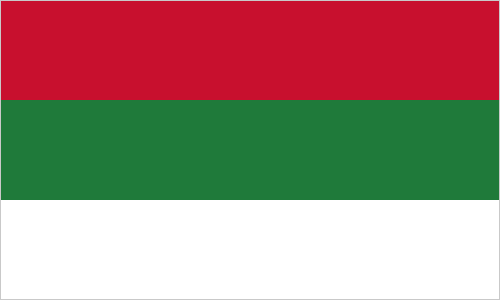
The flag is red, green and white, in three horizontal bands: the colours of Anhalt-Dessau from about 1815 and of the united duchy since 1863. The state flag adds the ducal arms. The arms are the house’s: the black bear walking on a red battlemented wall, the arms of Bernburg, quartered with the Saxon bars of black and gold crossed by the green crown of rue, which the Ascanian dukes of Saxony bore before the Wettins inherited them, and the red eagle of Brandenburg, which Albert the Bear’s descendants bore before the Hohenzollerns did. The duchy uses the arms, the flag and nothing more.
✎ Editor's Note · Why Anhalt is still a duchy, and Dessau still has the Bauhaus
In our world the Duchy of Anhalt ended in November 1918, when the Regent, Prince Aribert, abdicated on behalf of the seventeen-year-old Joachim Ernst, and it became the Free State of Anhalt until 1945. The Bauhaus left Dessau in 1932, driven out by a Nazi town council, and was closed in Berlin in 1933. Hugo Junkers was forced out of his own company by the Nazi state in 1933 and died in exile in Bavaria in 1935, on his seventy-sixth birthday. Dessau was bombed flat in March 1945, and after the war the Junkers works was dismantled by the Soviet occupation. Here Germany won the First Great War and had no revolution and no Nazi state, so the duchy survived, the Bauhaus stayed, and Junkers kept his firm until his death. The house is real down to Joachim Ernst (1901 to 1947), who here reigns until his death; everyone after him is invented, because the real head of the family is a living person. Jake chose the Junkers works as the duchy’s spine and had the French take Dessau for a fortnight in the winter of 1941, on the flank of the canon’s deep thrust to Berlin.
Chronology
| Year | Event |
|---|---|
| 959 | Margrave Gero founds the abbey at Gernrode |
| 1157 | Albert the Bear becomes the first Margrave of Brandenburg |
| 1212 | Heinrich I takes the title of Prince of Anhalt |
| 1320 | The Ascanian line in Brandenburg dies out |
| 1530 | Prince Wolfgang of Anhalt-Köthen signs the Augsburg Confession |
| 1596 | The house adopts the Reformed faith |
| 1603 | The principality is divided into Dessau, Bernburg, Köthen, Zerbst and Plötzkau |
| 1693 | The Old Dessauer succeeds in Anhalt-Dessau |
| 1706 | The Dessauer March is played at Turin |
| 1717 to 1723 | Bach is court Kapellmeister at Köthen |
| 1729 | Sophie of Anhalt-Zerbst, later Catherine the Great, and Moses Mendelssohn are born |
| 1744 | Sophie goes to Russia |
| 1769 | Father Franz begins the palace at Wörlitz |
| 1774 | The Philanthropinum is founded at Dessau |
| 1793 | The Zerbst line dies out |
| 1806 to 1807 | The principalities become duchies |
| About 1815 | Red, green and white become Anhalt-Dessau’s colours |
| 1821 | Hahnemann settles at Köthen |
| 1847 | The Köthen line dies out |
| 1859 | The constitution of 1859 |
| 1863 | The Bernburg line dies out on 19 August; Leopold IV Friedrich unites the duchy |
| 1866 | Anhalt sides with Prussia |
| 1871 | It enters the German Empire |
| 1883 | The Bernburg soda works is founded |
| 1888 | Hugo Junkers comes to Dessau |
| 1895 | Junkers & Co. is founded |
| 1900 | Kurt Weill is born at Dessau |
| 1908 | The Dessau synagogue is consecrated |
| 1915 | The J 1, the first all-metal aircraft, is built at Dessau and flies on 12 December |
| 1918 | Friedrich II dies in April and Eduard in September; Joachim Ernst succeeds under Aribert’s regency |
| 1919 | The F 13, the first all-metal airliner, flies on 25 June. The constitution is democratised |
| 1921 | Junkers Luftverkehr and FC Junkers Dessau are founded |
| 1924 | Joachim Ernst marries Countess Agnes |
| 1925 | The Bauhaus comes to Dessau. Wolfgang is born |
| 1926 | Junkers Luftverkehr is merged into Luft Hansa on 6 January; the Bauhaus building opens on 4 December |
| 1928 | Gropius’s Landtag building; Gropius leaves the Bauhaus |
| 1930 | Mies van der Rohe becomes director of the Bauhaus |
| 1932 | The Ju 52/3m enters service |
| 1935 | Hugo Junkers dies at Dessau on 3 February, his seventy-sixth birthday |
| 1936 | The works begins to build for the imperial air force |
| 1941 | The French hold Dessau from 11 to 24 December; the works is blown up on the night of the 23rd |
| 1942 | The works is rebuilt on the same site |
| 1944 | Kandinsky dies in his Masters’ House |
| 1947 | Joachim Ernst dies in March; Wolfgang succeeds |
| 1948 | The constitution of 1948 is promulgated on 19 August |
| 1950 | The Garden Realm Foundation is founded; Leopold is born |
| 1952 | The memorial at the works gate is raised |
| 1954 | Prince Friedrich is born |
| 1958 | Mies leaves the Bauhaus; the Wörlitz wing is rebuilt |
| 1960s | The works builds its last armed aircraft |
| 1966 | General Brisac comes to Dessau and goes up to the roof with Wolfgang |
| 1967 | The first Köthen Bach festival |
| 1975 | Leopold joins Junkers as a test pilot |
| 1976 | Wolfgang opens the Bauhaus’s new campus |
| 1979 | Leopold marries Katharina |
| 1985 | Wolfgang dies; Leopold succeeds |
| 1996 | Duchess Katharina dies |
| 1998 | Prince Joachim is born |
| 2002 | The Mulde flood; the apprentices save the Wörlitz dykes |
| 2003 | Prince Friedrich is killed testing the house’s Ju 52 |
| 2011 | The Ju 510 enters service |
| 2017 | Ulrich Sondermann becomes Staatsminister |
| 2019 | Werner Junkers becomes chief executive; Leopold attends the opening of Weimar’s Bauhaus museum |
| 2022 | Jens Arnold becomes Oberbürgermeister of Dessau |
| 2028 | Leopold flies himself to Heinrich I’s funeral in February; collapses on the airfield in October; Prince Joachim signs as his deputy; the Duke writes to Paul II on 26 October |
Trivia
- In-Universe The iron gate of the Junkers works at Dessau carries the words Hier begann das Metallflugzeug, here the metal aeroplane began, and every apprentice is photographed under them on the first day.
- In-Universe Every child in Anhalt is taken up once, at about ten, in the house of Anhalt's own Ju 52, on a twenty-minute flight over the Elbe, Wörlitz and Dessau. The aircraft is kept in the Katharina hangar, named for the late Duchess, who was a Junkers flight-test engineer.
- In-Universe Duke Leopold was flying a Junkers prototype over the Elbe when his father died in 1985, and he learned of his succession from the works' control tower, which told him to land.
- In-Universe On the night of 23 December 1941 the French commander in Dessau, Colonel Étienne Brisac, made the sixteen-year-old heir watch from the roof of the residence palace as his engineers blew up the Junkers works. In 1966 Brisac came back to ask his pardon, and the two men went up to the roof together.
- In-Universe Catherine the Great and Moses Mendelssohn were both born in the principalities of Anhalt in 1729, four months apart, and each left home at fourteen, she for St Petersburg and he, on foot, for Berlin.
- In-Universe Anhalt has the only Reformed state church among the German states. The union with the Lutherans that the other Protestant states made in the nineteenth century never took there, because the congregations refused the new liturgy and the synod refused to make them.
- In-Universe The Staatsminister, Ulrich Sondermann, calls the Bauhaus Dessau's luxury in every budget debate, and has voted its budget through every year since 2017.
- In-Universe Bernburg castle keeps brown bears in its moat, as a living version of the bear on the house's arms.
- In-Universe In Zerbst, north of the Elbe, they say that German begins at the river. In Köthen, south of it, they say that it stops there.
- In-Universe The crest of FC Junkers Dessau, the Fliers, was designed at the Bauhaus in 1927 and has never been changed.
- In-Universe In German an Anhalter is both a man from Anhalt and a hitch-hiker, and every Anhalter has heard the joke.
- Design Jake built the duchy from a hundred answers, made the Junkers works its spine, kept the Bauhaus at Dessau for the century the canon gave it, and had the French hold the town for a fortnight on the flank of the deep thrust to Berlin.
- Real-World The J 1 of 1915, the F 13 of 1919, the merger of Junkers Luftverkehr into Luft Hansa in 1926, the Ju 52 and Hugo Junkers's death on his seventy-sixth birthday in 1935 are all real. In our world the Nazi state had forced him out of his company two years before.
- Real-World In our world the Bauhaus left Dessau in 1932, after the Nazi party won the town council, and was closed in Berlin in 1933. Its Dessau buildings survived the war, were restored, and are among the most visited modern buildings in Europe.
- Real-World Bach's years at Köthen, Hahnemann's at Köthen, the Dessau-Wörlitz garden realm, the Old Dessauer, Gernrode's Holy Sepulchre, Sophie of Anhalt-Zerbst and the births of Mendelssohn, Weill and Wilhelm Müller at Dessau are all real. Dukes Wolfgang and Leopold and Prince Joachim are invented.
See also
- German Empire, of which the duchy is a constituent state
- Grand Duchy of Saxe-Weimar-Eisenach, which closed the Bauhaus in 1924 and sent it to Dessau
- Kingdom of Prussia, whose province of Saxony surrounds the duchy
- The Second Great War, and the deep eastern thrust on whose flank Dessau was taken
- Berlin, besieged for two weeks in December 1941
- House of Romanov, into which Sophie of Anhalt-Zerbst married
- Paul II, to whom Duke Leopold wrote on 26 October
- Heinrich I, to whose funeral the Duke flew himself
Categories
Nations of the World · The German Empire · Constituent states · Central Germany · Dessau · Aviation · The Bauhaus